The landlord's blog Getting people in
How to Run a Battle of the Bands in a Pub (Without the Rows)
A pub battle of the bands that runs on time: 4 or 5 bands, 20-minute sets, a fair vote, the shared gear rule, the 11pm licence line and a full run sheet.
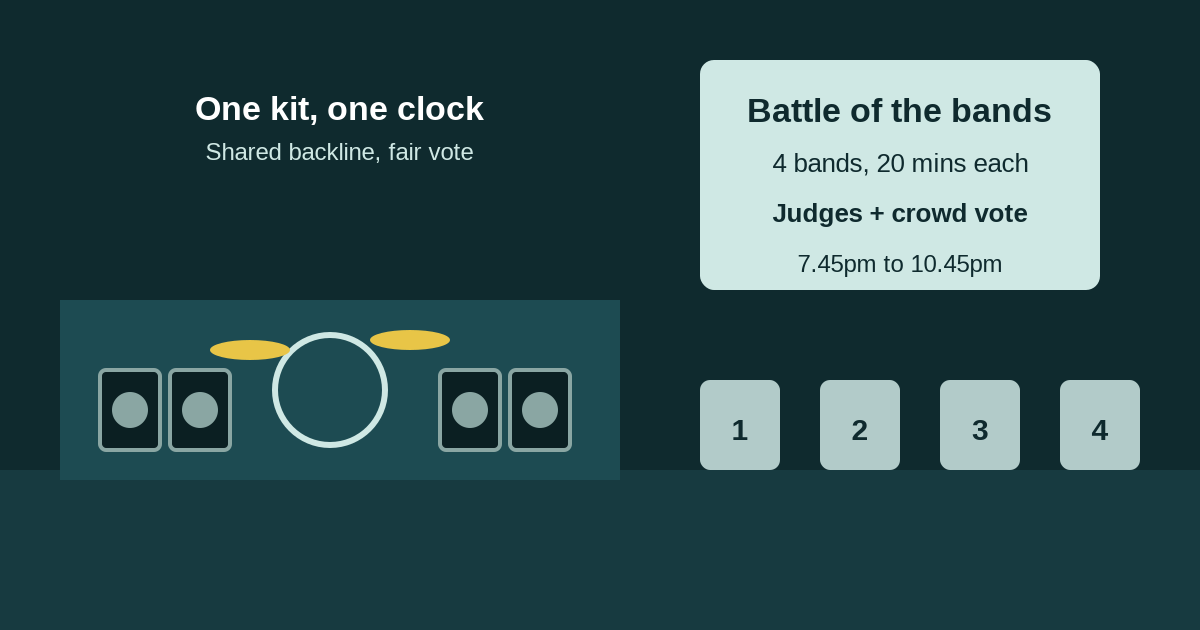
A battle of the bands is the one live music night where the acts bring the crowd for you. Four bands means four sets of mates, mams and dads, girlfriends and boyfriends, all in your pub on the same night, all wanting their lot to win.
It's also the night most likely to end in a row: a band that played 15 minutes over, a drummer who wouldn't share his kit, a vote that "wasn't fair", and the last band going on at quarter to eleven to an empty room.
This guide is how to run a battle of the bands in a pub so it runs on time and people come back for the next one: the format, the gear, judging and voting, prizes, licensing, the sums and a full run sheet. Sources are at the bottom.
The short answer
- 4 or 5 bands, 20-minute sets, 15-minute changeovers. That's about three hours of music and changeovers, which fits 7.45pm to 10.45pm.
- Share the backline. One drum kit, one bass amp, at least three amps between everyone. Agree it in writing before the night.
- Use a judges' panel plus a crowd vote. Publish the scoring before the night so nobody can say it was fixed.
- Don't charge bands to enter. Musicians' sites call pay-to-play a red flag. Charge the crowd a small door fee instead.
- Finish by 11pm and you usually need no entertainment licence in England and Wales. You still need TheMusicLicence.
Is it right for your pub?
A battle of the bands suits a pub with a corner that can take a drum kit, a crowd that doesn't mind loud for a night, and a local scene with bands looking for gigs. It's a strong midweek or Sunday event, because the bands bring their own audience.
It's not right if you have neighbours above the bar, a room that empties the minute the music gets loud, or no one who can run the night. Somebody has to hold the clock. If that's you and you're also on the bar, get help.
The format: how many bands and how long
The guides that rank for this disagree a lot. Last Minute Musicians, writing for bands, says some competitions give 15 to 30 minutes and others only 5 to 15. A guide on Guitarnoise, written from the organiser's side, says anything less than 20 minutes is a waste of effort, and to plan on 15 minutes between each act. A US contest rule book from the Charleston City Paper set sets at no longer than 20 minutes with 15 to 20 minutes between them.
For a pub, 20 minutes is the sweet spot. Long enough to show what they can do, short enough to keep the night moving.
Here's the sum for a pub that wants to finish by 11pm:
- 5 bands x 20 minutes = 100 minutes of music.
- 4 changeovers x 15 minutes = 60 minutes.
- Results and a winner's song: about 15 minutes.
- Total: about 2 hours 55 minutes.
Start at 7.45pm and you finish around 10.40pm, with a bit of slack. Four bands gives you more slack and a shorter night. Six is too many for one pub night: run heats instead.
Heats and a final. Bigger contests run heats, then a semi-final, then a final. For a pub, four heat nights with four bands each, then a final with the four winners, gives you five busy nights from one idea.
Running order. Guitarnoise suggests one band goes first to check the PA. Draw the rest out of a hat in front of the band reps so nobody can moan. Bands with the biggest following often want to go last. Don't let them all bunch up at the end: the room empties after each band's mates have seen them.
Gear: the shared backline rule
This is where most battle of the bands nights fall apart, because every changeover becomes a full set-up.
- Shared drum kit. One kit stays on stage all night. Drummers bring their own snare, cymbals and pedal (the "breakables"). Guitarnoise says each band should replace any drumhead it breaks.
- Shared bass amp. A UK guide on PMT says it makes sense to share one bass amp.
- Guitar amps. The same PMT guide says guitarists prefer their own amps, so if the stage is small, ask them to share and "be prepared to be ignored". Guitarnoise says to have at least three amps on site.
- A master list. Ask every band what they're bringing and what they'll share, and write it down. Guitarnoise calls this keeping a master list. Send it to all the bands a week before.
Get the shared kit and PA sorted by one person: a sound engineer if you can afford one, or the most organised band. Have the PA set up at least an hour before the first band, as Guitarnoise suggests.
Judging and voting: make it fair and say how
Most contests pick a winner with a panel of judges, the crowd, or a mix of both. For a pub, a mix works best. A pure crowd vote just rewards the band with the most mates. A pure judges' vote feels like a fix to the losers' families.
A simple 50/50 system:
- Judges (50%). Three judges: a local musician, someone from a music shop or rehearsal room, and one neutral person who isn't the landlord. The Charleston contest scored five things: stage presence, singing, technique, crowd interaction and originality. Give each a mark out of 10.
- Crowd (50%). One vote per person. Eventgroove, writing about fundraiser battles, suggests a jar or container per band and "one vote equals one ticket". In a pub, the simplest way is a token with each door ticket that goes in the band's jar.
Say how it works before the night. Put the scoring on the event page and read it out at the start. Count the votes with a band rep watching. Announce the winner with the scores. If a vote is close, it's far better to show the numbers than to have a row in the car park.
Prizes: what bands actually want
Last Minute Musicians says pub-level prizes are usually a small cash prize, a bar tab, or a trophy and bragging rights. Bands also value:
- A paid gig. "Winner gets a paid Saturday slot" costs you a fee you'd pay anyway and gives you a band that already pulls a crowd.
- Recording time at a local studio (ask them to sponsor it for a mention).
- A trophy that lives behind the bar with the winners' names on it. It keeps the idea going year after year.
More on picking prizes people actually want in prizes that bring people back.
Don't charge bands to enter. Last Minute Musicians says being asked to pay to enter any competition can be a major red flag. Charge the crowd at the door instead.
Tickets, door price and promotion
The PMT guide gives a fair rule: when entry costs more than a pint, people start to think twice. It suggests £5 up North at the most. For a pub battle of the bands, £3 to £5 on the door, or free with a voting token at the bar, is about right.
Promotion. PMT says give yourself at least a month to spread the word. Eventgroove says at least four to six weeks.
- Ask every band to share the event and bring their crowd. It's in their interest: their mates are their votes.
- Make one Facebook event with every band tagged.
- Put the line-up and set times on your pub tellys from the day it's booked.
- Post each band's best clip in the week before.
Licensing, music licences and noise
GOV.UK says live or recorded music needs no entertainment licence between 8am and 11pm at an alcohol on-licensed premises, for an audience of no more than 500. That covers a pub battle that finishes by 11pm. Between 11pm and 8am it needs to be licensed, so keep to the clock or check your premises licence, or use a temporary event notice. Our guide on how to book live music for a pub goes through it in full.
You still need a music licence. PPL PRS gives an example, updated in November 2026, of a pub putting on live music at a one-off event for up to 100 people for £14.64 plus VAT. Original songs and covers are both music. Tell them about the night.
Noise. Five loud bands is louder than one. Shut doors and windows during sets, check your premises licence for noise conditions, and keep the last band to time. Neighbours put up with one late night a lot better than a regular late night.
Under-18 bands. Young bands are common in these contests. Check your premises licence conditions on children before you accept them, and ask for a responsible adult with each one.
The money: does it pay?
A worked example. It's the sum to do before you book, not a promise.
Costs: say a £100 bar tab prize, a £25 trophy and £100 for someone to run the sound (or nothing if a band does it). About £225.
Door: 90 people at £4 = £360. The door covers the night.
The bar: the bands' crowds drink. Say 90 people spend £15 each = £1,350 of extra takings on a night that might otherwise have had 30 in. If you make about 60p in every pound on that (check your own GP), that's around £810 gross profit, before staff.
The bad night: three bands turn up, 40 people in, £160 on the door. You've still roughly covered the prize and the trophy, and the bar has done better than a dead Wednesday.
That's why a battle of the bands is lower risk than booking one big act: you're not paying four fees.
Run sheet for the night
- 5.30pm: PA and shared kit set up. Stage corner cleared.
- 6.30pm: Bands arrive. Running order drawn from a hat with band reps.
- 7.00pm: Sound check, first band only (as the PA check).
- 7.30pm: Doors. Voting tokens with every ticket.
- 7.45pm: Host welcome, how the scoring works, band 1.
- 8.05pm: Changeover. Bar busy.
- 8.20pm: Band 2. Then repeat: 20 minutes on, 15 minutes changeover.
- 10.25pm: Last band finishes. Votes counted with a band rep watching.
- 10.35pm: Results with scores. Winner plays one song.
- 10.45pm: Music off. Mention the next event.
If you're running late, Guitarnoise's advice is to take a few minutes off each band rather than drop the last one. Tell every band at sound check that 20 minutes means 20 minutes, and give them a two-minute warning.
Frequently asked questions
How long should each band play at a battle of the bands?
For a pub, 20 minutes is about right, with 15 minutes between bands to change over. Some contests use shorter sets of 5 to 15 minutes, but one organiser's guide says anything under 20 minutes is a waste of effort. Five bands at 20 minutes fits a 7.45pm to 10.45pm night.
How do you judge a battle of the bands?
Most contests use a panel of judges, a crowd vote, or both. For a pub, half judges and half crowd vote works well. Judges can score stage presence, singing, technique, crowd interaction and originality, and the crowd can vote with one token per ticket.
Should bands pay to enter a battle of the bands?
No. A big musicians' booking site warns that being asked to pay to enter can be a major red flag, and it puts good bands off. Charge a small door fee to the crowd instead, around £3 to £5 in a pub, and let the bar cover the rest.
Do I need a licence for a battle of the bands in my pub?
In England and Wales, live music at an alcohol licensed pub needs no entertainment licence between 8am and 11pm for an audience up to 500. After 11pm you need it covered by your premises licence or a temporary event notice. You still need TheMusicLicence.
What prizes do you give at a battle of the bands?
At pub level, a small cash prize, a bar tab or a trophy is normal. A paid gig at your pub, recording time sponsored by a local studio, and a trophy that stays behind the bar with the winners' names are prizes bands tend to value.
Sources
- Last Minute Musicians: Battle of the bands: how it works, prizes and is it worth it?
- Wikipedia: Battle of the bands
- Guitarnoise: Battle of the bands
- Eventgroove: What is a battle of the bands fundraiser?
- PMT: How to put on your own gigs
- Charleston City Paper: Battle of the bands: rules of engagement (2009)
- GOV.UK: Entertainment Licensing
- PPL PRS: Music licence cost examples
We checked every source on 24 November 2026. Rules change, so check the latest version before you act. Nothing here is legal advice.