The landlord's blog Getting people in
How to Book Live Music for a Pub: Costs, Licences, Contracts
What a pub band really costs in 2026, the 11pm and 500-people licence rule, the music licence you still need, and the 8 things to agree before the gig.
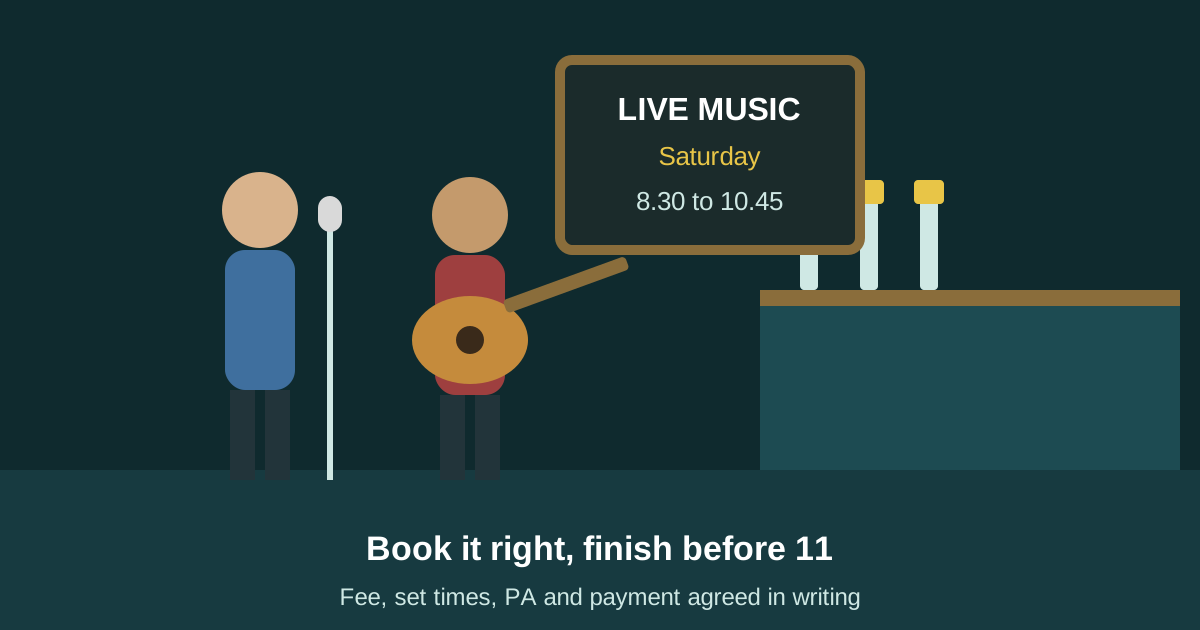
Live music can turn a flat Saturday into the night people talk about on Facebook on Sunday morning. It can also turn into a band you've never heard of turning up at half eight with no PA, playing too loud for the room, finishing at quarter past eleven and asking for cash you thought you'd agreed was less.
This guide is how to book live music for a pub without the headaches: what acts actually cost in 2026, the licensing (simpler than most people think), the music licence you still need, where to find acts, what to agree in writing and how to make the night pay. Sources are at the bottom.
The short answer
- Budget roughly £160 to £600 a night. One booking platform puts solo acts at £162 to £330, duos at £250 to £500 and three or four-piece bands at £275 to £600.
- Know the Musicians' Union rate. Its recommended minimum for a pub gig of up to 3 hours is £167.16 per musician (April 2026). Many gigs pay less, but it's a fair benchmark.
- No entertainment licence is needed for live music in a pub licensed for alcohol, between 8am and 11pm, for an audience of up to 500. That's England and Wales.
- You still need TheMusicLicence from PPL PRS to cover the songs. Live music goes on the same licence, charged per event.
- Get it in writing: fee, set times, finish time, PA, sound limiter, parking, food and drink, and when they're paid.
- Pay on the night, feed them, and they'll come back.
What a pub band costs
Prices vary with the size of the act, how long they play and how far they travel. GigXchange, a booking platform, publishes typical UK pub fees:
- Solo acoustic: £162 to £330. The default pub booking. Usually brings their own small PA.
- Duo: £250 to £500. Two voices fill a room far better than one. Good value for most pubs.
- Three or four-piece band: £275 to £600. Drums change everything: more space, more set-up, more volume. Worth it on a Friday or Saturday, rarely midweek.
What pushes a fee up, according to the same guide: travel over about 30 miles, a finish after 11pm, or a third set. Say all three when you ask for a price.
The Musicians' Union rate
The Musicians' Union publishes recommended minimum rates. For musicians in groups playing pubs and clubs, for an engagement of up to 3 hours, it's £167.16 per musician (April 2026). So a four-piece on MU rates would be about £669 before travel and extras. The MU also sets out:
- Set-up time is paid from when the musician has to be set up, not when they start playing.
- Breaks of at least 15 minutes per 2 hours playing.
- Late fee of £37.50 if they get home between midnight and 2am.
- Mileage of 56p a mile, plus any parking or tolls paid by whoever booked them.
You'll find plenty of pub acts charging less than MU rates, especially solo players building a following. Just know that if you're paying a four-piece £250, they're playing for petrol money and may not stay loyal.
Other ways to pay
The MU lists the deals musicians are commonly offered: a guaranteed fee, a fee plus a share of the door, the whole door take, or a share of the profits. For a pub with no door charge, a straight fee is simplest. If you charge on the door, a fee plus a percentage of the door is fair to both sides.
Licensing: what you need
The entertainment licence (you probably don't need one)
This is the bit people get wrong. GOV.UK's entertainment licensing guidance says a licence isn't required to stage live music, or to play recorded music, if:
- it takes place between 8am and 11pm, and
- it's at alcohol on-licensed premises (a pub with a premises licence), and
- the audience is no more than 500 people.
Unamplified live music doesn't need a licence anywhere between those hours. The Musicians' Union adds that this comes from the Live Music Act 2012 and its 2015 extension, and that it applies in England and Wales only. Scotland and Northern Ireland have their own rules.
So for most pubs, a band that finishes by 11pm needs nothing extra from the council.
After 11pm, or a big crowd
GOV.UK says a licence may be required for any entertainment between 11pm and 8am, or amplified music to more than 500 people. If your premises licence already allows live music later, you're fine within its conditions. If not, the pub trade body's guide to hosting live music says you may need a Temporary Event Notice, with 10 working days' notice (or five for a late notice). Our guide to Temporary Event Notices explains how they work.
TheMusicLicence (you definitely need one)
Copyright is separate from licensing. GOV.UK says you usually need TheMusicLicence from PPL PRS to stage live music events in public or play recorded music at your business. It applies whether the act plays covers or their own songs.
Most pubs already have it for background music. If you're adding live music, tell PPL PRS. Its own cost examples (correct as of November 2026) say a pub or bar could put on live music for up to 100 people at a one-off event for £14.64 plus VAT. Your exact cost depends on your venue and how often you have music, so get a quote. We've also covered music licences for quiz rounds and music bingo and the main StockTap site has a guide to what a pub music licence costs in 2026.
DJs and backing tracks
The trade body's guide notes that if a DJ uses digital copies of tracks, they need a ProDub licence. That's their responsibility, but ask. If you're playing your own downloaded playlists between sets, you may need extra cover on top of TheMusicLicence, so check with PPL PRS.
Noise and your own licence conditions
Read your premises licence before you book. Many have conditions about noise, windows and doors, or a sound limiter. The trade body's guide suggests simple steps like closing windows and outside doors, and thinking about noise from the band packing up after. Neighbours who complain can lead to a licence review, so keep it reasonable from the first night.
Where to find acts
- Ask other landlords who's good and who's reliable. A recommendation beats any demo.
- Go and watch. Visit other pubs on a Saturday. You'll see how an act handles a pub crowd, not a perfect recording.
- Local Facebook groups for musicians and venues in your area.
- Booking platforms and directories where acts list their fees, clips and available dates. Filtering by who's free on your date saves weeks of messages.
- Colleges and music schools for younger acts looking for gigs, as the trade body's guide suggests.
- Run an open mic. GigXchange makes the point that your own open mic is the best audition room there is: every act within driving distance, in front of your own crowd.
- Agencies for one-offs. GigXchange says they typically add 15% to 20% commission, sometimes up to 25%. Worth it for a big night where a no-show would be a disaster; less so for a regular monthly slot.
Agree these 8 things in writing
GigXchange says the most common cause of a dispute is a fee agreed on partial information. The MU says hidden deductions (charging the band for PA hire or promotion) are a common complaint from musicians. A short email or a simple contract covers both of you. Agree:
- The fee, and what it includes (travel, extra sets).
- When and how they're paid. On the night, by bank transfer or cash, before they leave.
- Arrival, set-up and soundcheck time, ideally before the pub gets busy.
- Set times and the finish time. Two sets with a break is normal. Make the last song before 11pm unless your licence allows later.
- Who brings the PA and lights. Solo acts usually bring their own; bands may expect a house system.
- Volume and any sound limiter. Tell them what it's set to before they arrive.
- Parking and load-in. Which door, where to park, who'll be expecting them.
- Food and drink. A meal and a couple of drinks is cheap goodwill. Say whether it's included.
Also ask whether they have their own public liability insurance, as the trade body's guide recommends, and make sure your own insurance covers live events.
Most musicians are self-employed and should invoice you. Keep the invoices with your accounts.
On the night
- Put the act where people already stand, not in a far corner to protect the bar. GigXchange says the far corner kills the atmosphere and the act plays to an empty half of the room.
- Check the sockets. How many 13A sockets are near where they'll set up? Don't let them run extension leads across a walkway.
- Be there. Meet them, show them where everything is, and tell your staff who's in charge.
- Watch the volume early. A quiet word after the first song is easier than an argument at 10pm.
- Pay them before they leave. GigXchange calls late payment the number one complaint working musicians make about pubs.
Making live music pay
A £300 band has to earn its money back through the till. Here's an example sum, with illustrative figures rather than anyone's real takings:
- Duo: £300 for two sets.
- Extra crowd: say 40 more people than a normal Saturday, each buying three drinks at £4.50. That's 40 x 3 x £4.50 = £540 extra through the till.
- Gross profit on that: if your drinks run at around 60% GP, that's about £324, just covering the band. Food, a door charge or a bigger crowd is what turns it into a profit.
So it's not a guaranteed money-maker. The pubs that make it work:
- Book acts with a following, and ask them to share the event with their fans.
- Stick to a regular slot, like the last Saturday of the month, so people plan around it.
- Promote it two to six weeks ahead, with the act tagged on Facebook, and put it on your screens and table talkers.
- Pick the right act for the night. A solo act on a quiet Thursday; a band for a busy Saturday.
- Track it. Compare takings with a normal night for that day. If it isn't paying after a few months, change the act or the night. Our guide on getting more customers on quiet midweek nights has other ideas to test.
Frequently asked questions
Do pubs need a licence for live music?
Not for entertainment licensing in most cases. In England and Wales, live music needs no licence in a pub licensed for alcohol between 8am and 11pm for an audience of up to 500. You still need TheMusicLicence from PPL PRS for the songs, and after 11pm your premises licence or a Temporary Event Notice decides it.
How much does it cost to book a band for a pub?
Typically about £160 to £600 a night. One booking platform puts solo acts at £162 to £330, duos at £250 to £500 and three or four-piece bands at £275 to £600. The Musicians' Union recommends at least £167.16 per musician for a pub gig of up to 3 hours.
Do I need a PRS licence for live music in my pub?
Yes, you need TheMusicLicence from PPL PRS, which has replaced the separate PRS and PPL licences. Live music is added to the same licence and charged per event. PPL PRS's own example is £14.64 plus VAT for live music to up to 100 people at a one-off event.
Can live music go on after 11pm in a pub?
Only if your premises licence allows it or you give a Temporary Event Notice. The Live Music Act exemption stops at 11pm. Check your licence conditions for regulated entertainment and noise before you advertise a late finish.
Should I pay a band in cash on the night?
Pay how you've agreed, but pay before they leave. Cash or a bank transfer on the night both work. Ask for an invoice, as most musicians are self-employed, and keep it with your accounts.
Where can I find bands for my pub?
Ask other landlords, watch acts at nearby pubs, try local musicians' Facebook groups, use booking platforms that show fees and available dates, and run an open mic to see local acts in front of your own crowd.
Sources
- Musicians' Union: Hiring a live musician for a pub or small venue
- Musicians' Union: National Gig Rates, April 2026
- Musicians' Union: Live engagement rates of pay
- GOV.UK: Entertainment Licensing
- GOV.UK: Get a licence to play live or recorded music
- PPL PRS: Music licence cost examples
- British Beer and Pub Association: The essential guide to hosting live music events in your pub
- GigXchange: How to book live music for your pub or bar
We checked every source on 20 November 2026. Rules change, so check the latest version before you act. Nothing here is legal advice.