Sell Ads on Your Pub TVs: What to Charge Local Businesses
What to charge the barber and the taxi firm for an ad on your pub tellys, how often it should play, the rules to follow and how to prove it works.
Think about who walks past your tellys in a week. The same faces, from the same few streets, a few times each. Now think about who'd pay to be in front of them. The barber two doors down. The taxi firm everyone rings at closing. The lass who does nails from her front room. The plumber whose van's in your car park every Friday.
Most of them will never pay for a billboard or a proper advertising campaign. But a few quid a month to be on the screens in their local? That's a different conversation.
This guide is how to sell advertising on your pub TV screens to local businesses: what to charge, how often an ad should play, what to put in a simple agreement, the rules to stick to and how to show them it worked. I've included what we offer at Teal Farm, and the sources are at the bottom.
The short answer
- Sell to small local firms, not big brands. Your screens reach a few hundred local people again and again. That suits a barber, not a bank.
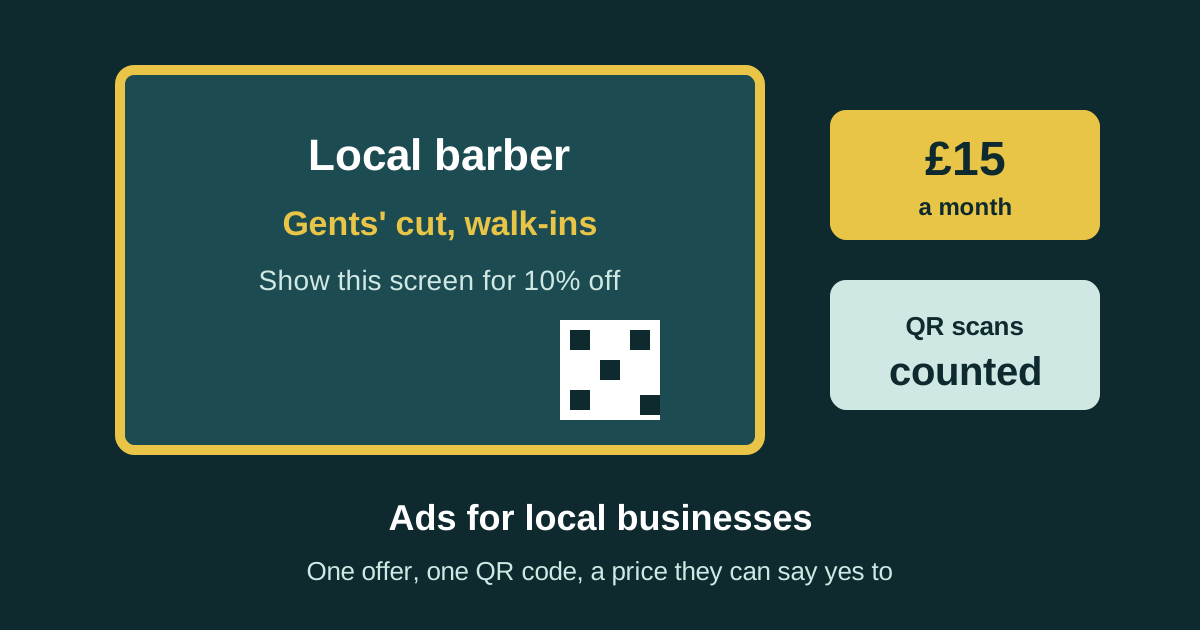
- Keep the price small enough to say yes to. We offer local businesses a founding price of £15 a month at Teal Farm.
- One business per trade. It's easier to sell and they'll stay longer.
- Make the ad for them. Most small firms haven't got one and won't make one.
- Put a QR code on every ad and count the scans. That's your proof at renewal time.
- Follow the advertising code, turn down anything you wouldn't want your family-time customers to see, and keep a simple written agreement.
Why a pub screen beats a billboard for a small business
Proper digital advertising screens, the ones at stations and on roadsides, aren't built for the corner shop. The Internet Advertising Bureau's guide to digital out-of-home advertising for small businesses says minimum orders start at about £2,500 to £5,000 for a burst of a few weeks. Its example for £5,000 is a two-week run on a few dozen screens across stations and roadsides.
That's fine for a car dealer. It's no use to a barber with one chair. What a pub offers is the opposite: one place, a small crowd of locals, for months on end, at a price a one-man band can afford.
And people in a pub are looking up. They're waiting at the bar, waiting for the quiz, waiting for kick-off. Our guide on whether anyone reads pub TVs goes into what actually gets noticed.
Who to sell to
Start with the businesses your customers already use. Walk out of your front door and write down every one within a mile. Then add the ones whose vans are in your car park.
Good fits for a pub screen:
- Taxi firms. Your customers need one at closing time. Perfect.
- Barbers and hairdressers, nails and beauty.
- Trades. Plumbers, electricians, roofers, window cleaners, joiners.
- Driving instructors and tutors. Mams and dads drink in pubs too.
- Gyms, dance schools and kids' clubs.
- Estate agents and letting agents who work your streets.
- Local events. The church fair, the club's race night, the school Christmas fair.
Think twice about:
- Anyone who competes with you. A takeaway ad on the telly while your kitchen's open is daft.
- Bookmakers and gambling. More on that below.
- Anything you'd be embarrassed by with families in on a Sunday.
What to charge
There's no going rate for this, so here's how I'd think about it.
Start low and fill the slots. We offer a founding price of £15 a month at Teal Farm. It's an easy yes from someone who already drinks in your pub.
Do the sums on what it's worth to you. Ten local businesses at £15 a month is £150 a month, or £1,800 a year. At £25 a month it's £250 a month, or £3,000 a year. That's for content you'd have on the screens anyway.
Charge more for the best screens or times. A slot that only plays on football nights, or on the TV everyone faces, can cost more once you've got a waiting list.
Make the first month risk-free. At Teal Farm our offer includes a full refund on the first month, and if their ad gets no QR scans in month one, month two is free. It takes the fear out of saying yes, and it gives you a reason to make the ad good.
Keep the price for founding advertisers. The first few who take a chance on you should keep their price while they stay. It's a good reason to sign up now rather than next year.
How often should each ad play?
The IAB guide says digital screens typically show an ad for about 10 seconds at a time. That's a good length for a pub too. Long enough to read one line and a phone number, short enough that nobody gets sick of it.
Here's the sum. Say your screens run a five-minute loop. Put ten local ads in it at 10 seconds each, that's 100 seconds of ads, and the rest is your own offers, what's on and a quiz. Each ad then plays 12 times an hour. Over a 12-hour day, that's 144 times on every screen.
Don't cram the loop with ads. If the screens are wall-to-wall adverts, your customers stop looking, and then the ads are worth nothing. I'd keep ads to about a third of the loop at most, and keep your own stuff and something to play in between. Our guide on cheap ways to put offers on pub TVs has more on mixing it up.
Make the ad for them
Most small businesses haven't got a screen ad and won't know how to make one. If you make it, you'll get far more yeses, and the ads will look right on your screens.
The IAB's advice for screen ads is to keep it simple: the headline should stand out and be easy to read quickly, and the logo should be clearly visible. In a pub I'd go further:
- One message. "Gents' cut £12, walk-ins welcome" beats a list of services.
- Big words. Readable from the furthest seat, same as anything else on your screens.
- A reason to act now. "Show this screen for 10% off this month."
- A QR code to their booking page or phone number.
- No sound. Most pub screens are muted most of the time.
Ask for their logo, their offer and a photo of their work. Then send them a picture of the finished ad to approve before it goes up. The IAB guide notes that big screen networks usually want artwork at least five working days before a campaign starts. You can be faster than that, and it's a selling point.
The rules to stick to
I'm not a lawyer, so check anything you're unsure of. But these are the bits I'd know about.
The advertising code
The UK Code of Non-broadcast Advertising (the CAP Code) applies to posters and other promotional media in public places, including moving images, according to the Advertising Standards Authority's page on its scope. In plain words, ads on your pub screens should be legal, decent, honest and truthful like any other ad. Don't let anyone put up claims they can't back up, like "cheapest in the North East", and keep a copy of every ad you've shown.
Gambling ads
The Advertising Standards Authority says gambling ads must not be targeted at, or likely to be seen by, under-18s through the media they appear in, and must not be of strong appeal to under-18s. If you've got families in during the day, that's a good reason to say no to gambling ads altogether. That's what I'd do.
Planning permission for ads
GOV.UK's guidance on the advertisement rules says advertisements displayed inside buildings come under a class with deemed consent, which means you don't normally need to apply, as long as the conditions are met. A screen outside, or one facing the street through a window, may not fit so neatly. If in doubt, ask your council's planning team.
Your lease or tie
If you're a tenant, read your agreement before you sell space on your screens, in case it says anything about advertising or third-party income. A quick email to your area manager saves an argument later.
Tax
Advertising money is business income. Tell your accountant so it goes through the books properly.
A simple agreement
You don't need a solicitor for a £15 a month deal, but you do need it written down. One page, signed by both of you, covering:
- What they get: which screens, how long the ad is, roughly how often it plays.
- The price: monthly, paid in advance, by card or standing order.
- How long: month to month, or a minimum term. We say cancel any time.
- The content: you make it, they approve it, and you can refuse or pull anything that breaks the advertising rules or upsets customers.
- Changes: how often they can change the offer, for example once a month.
- One per trade: if you promise it, write it down.
- What happens if a screen's off: for example, a free week if the screens are down for a week.
Prove it works
This is what gets the renewal. If you can show a business their ad was seen and used, they'll stay. If you can't, they'll drift off after three months.
- A QR code with a scan counter on every ad. At Teal Farm every QR code on our screens has a scan counter, and each local business can have its own report page showing its ad's plays and scans.
- A code word. "Say Teal Farm for 10% off" lets the barber count customers himself.
- A monthly message. One line, for example: "Your ad played this many times this month and got this many scans." Real numbers only, straight from the counter.
And be honest when an ad isn't working. Change the offer, change the picture, move it to a different time. That's why we give month two free when there are no scans in month one: it forces us both to fix the ad instead of hoping.
Selling it
You know these people already, which makes this the easiest sale you'll ever do.
- Put an ad for your ads on your own screens. We run one at Teal Farm: "Got a local business? Get your ad on every screen in here", with the price and a QR code to sign up.
- Ask your regulars. Half of them run a small business, or know someone who does.
- Walk round the street with a printout of what their ad would look like. A picture of their own ad on your telly sells it in ten seconds.
- Start with one business per trade, and tell the next one there's only one taxi slot left. Because there is.
If you're still sorting out how to get content onto your screens at all, start with our guide to pub digital signage. Then come back to this.
Frequently asked questions
Can a pub sell advertising on its TV screens?
Yes. Plenty of pubs show their own offers, and there's nothing stopping you selling space to local firms. Follow the advertising code, avoid gambling ads if children are in, check your lease or tie, and keep a written agreement. Ads inside the building normally have deemed planning consent.
How much should a pub charge for TV advertising?
There's no set rate. We offer local businesses a founding price of £15 a month at Teal Farm, with the ad made for them. Ten businesses at £15 is £1,800 a year. Charge more for the best screens or times once you have a waiting list.
How long should an ad be on a pub TV?
About 10 seconds is a good length, which is typical for digital screens according to the Internet Advertising Bureau. In a five-minute loop with ten ads, each one plays 12 times an hour. Keep ads to about a third of the loop so people keep looking.
Do I need planning permission for ads on screens in my pub?
GOV.UK's guidance says advertisements displayed inside buildings have deemed consent if they meet the class conditions, so you don't normally apply. A screen outside, or one facing the street through a window, may be different, so check with your council's planning team.
Can a pub show gambling adverts on its TVs?
The advertising rules say gambling ads must not be targeted at or likely to be seen by under-18s through the media they appear in. If children come into your pub, the simplest answer is not to take gambling ads.
How do I prove to advertisers that pub TV ads work?
Put a QR code with a scan counter on every ad, add a code word they can count at their till, and send them a short monthly report with real plays and scans. If an ad gets nothing, change the offer instead of waiting for them to cancel.
Sources
- Internet Advertising Bureau UK: A guide to DOOH advertising for small businesses
- Advertising Standards Authority: Scope of the CAP Code
- Advertising Standards Authority: Keeping gambling advertising responsible and protecting young people (2026)
- GOV.UK: Advertisements: planning guidance
We checked every source on 19 November 2026. Rules change, so check the latest version before you act. Nothing here is legal advice.