The landlord's blog Rules and licences
Is bingo legal in pubs? The £5, £2,000 and no-fee rules explained
Yes, but only on strict terms. Cash bingo, charity bingo and free games with prizes in a UK pub, the exact limits, what lands landlords in bother and a checklist.
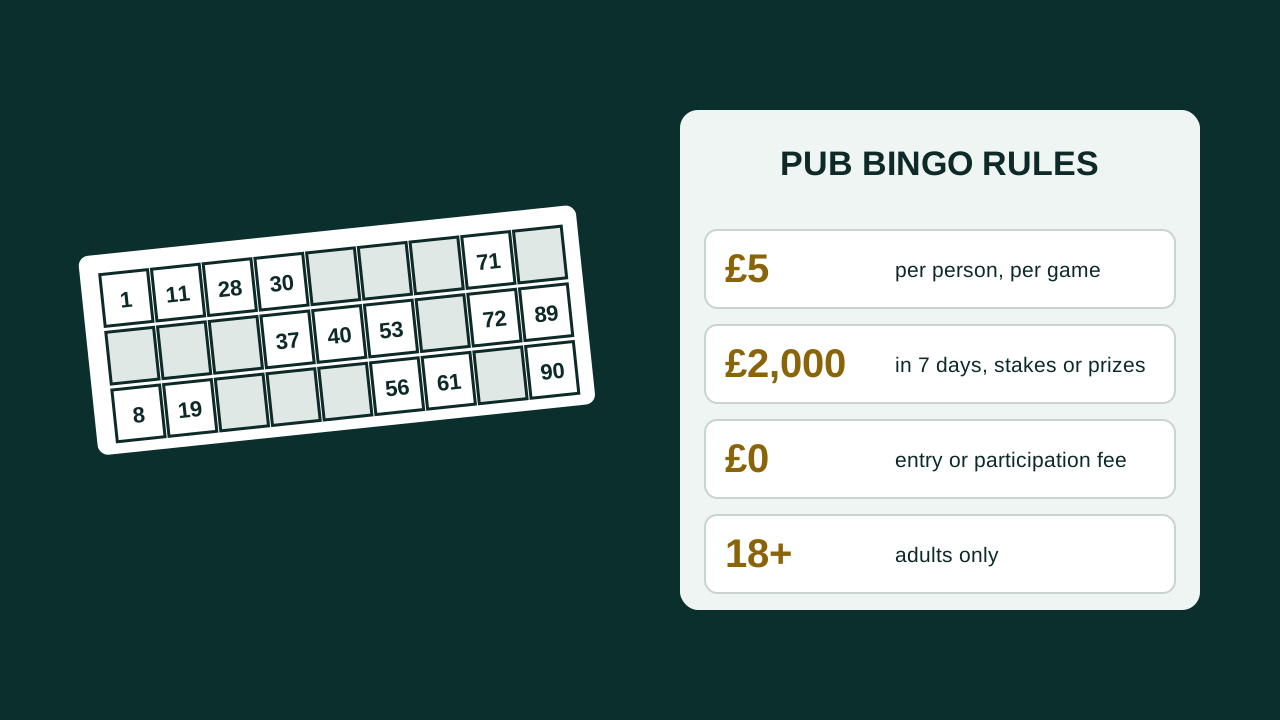
"Can we do a bingo night? Is that even allowed in a pub?" It's a fair question. Maybe a regular has done one at a social club, or a charity wants to use your function room, or you just fancy something for a quiet Wednesday.
The answer is yes, bingo is legal in pubs. But only on terms that are a lot tighter than most people expect. The pub can't keep a penny of the ticket money. There's a cap on what each person can pay. There's a weekly limit that almost nobody has heard of. And there's no entry fee, full stop.
This guide goes through the rules for every kind of pub bingo: cash games, charity nights and free games. It's based on the Gambling Commission's own guidance and what licensing solicitors have written about it. It isn't legal advice. Rules change, and your council's licensing team has the final say on your premises.
If you just want to know how to run the night, read how to run a bingo night in a pub. This one is the rules.
The short answer
Bingo is legal in a pub with an alcohol licence, with no gambling licence needed, if you follow the Gambling Commission's rules for "exempt gaming":
- every player has the same chance of winning
- nobody under 18 takes part
- the stake is no more than £5 per person, per game
- all the stakes go back as prizes
- no entry fee or participation fee for the bingo
- no linked games with other pubs
- not played virtually or online
- stakes or prizes stay under £2,000 in any seven days
Break those and you're not running exempt gaming any more. You're providing gambling without a licence.
Who's responsible
In England and Wales it's the designated premises supervisor, the DPS. The Gambling Commission's code of practice says compliance "should be the responsibility of a designated person". In Scotland it's the premises manager.
So if the function room bingo goes wrong, it's not the charity or the regular who organised it who answers for it. It's whoever's name is on the licence as DPS.
The rules for cash bingo, one at a time
£5 per person, per game
The Commission's code says all gaming in pubs, apart from dominoes and cribbage, has a stake limit of £5 per person per game. For bingo, that means if tickets are £1, nobody can buy more than five for one game. At 50p, ten. Players have to be told the limit, so put it on the rules card.
Every penny back as prizes
This is the big one. The Commission says all stakes must be returned as prizes, and you cannot "make a profit from the game, even if you intend to donate the profits to charity or good causes".
You also can't take a cut. No rake, no levy, no "10% for the kitty". The Commission says it doesn't matter whether that charge is voluntary or compulsory.
No entry or participation fee
You can't charge people to play the bingo, and you can't charge them to get in to play. If the bingo is part of a bigger event with paid entry, the Commission says people who will be playing bingo must be able to enter the pub without paying the entry fee.
Watch out for bundles. Imogen Moss of Poppleston Allen, writing in the Morning Advertiser in March 2025, says putting food, drinks and bingo cards together for one price counts as a participation fee. So "£10 for a curry and your bingo" is out. Sell the curry. Sell the tickets. Keep them separate.
The £2,000 in seven days rule
This one catches people out because it's about the whole week, not one night.
If the bingo in your pub goes over £2,000 in any seven-day period, either in money taken or prizes awarded, that's "high turnover bingo". The Commission's guidance to councils says there's a legal duty on the licensee to tell the Commission. The high turnover period then lasts a year. If it happens a second time in that year, you need a bingo operating licence.
Two things to watch:
- It's a rolling seven days, not Monday to Sunday.
- Prizes count too. If the pub tops up the house prize with a £100 voucher, that's £100 towards the £2,000.
A pub doing one £1-a-ticket bingo night a week with 40 players is nowhere near it. A pub doing bingo four nights a week with big added prizes could be over without noticing. Keep a log of stakes and prizes for every game.
Adults only
Under-18s can't take part in exempt gaming. The code of practice says games should be in areas for adults, staff should check the age of anyone who looks under age, and anyone who can't show acceptable ID should be refused. Acceptable ID means a photo card with a date of birth, like a PASS card, a photocard driving licence or a passport.
Poppleston Allen also point out that a child shouldn't mark a card on behalf of an adult. So no letting the bairns dab for their mam.
Only while the bar's open
Imogen Moss says games can only be played at times when alcohol can be supplied under the premises licence, and that the sale of alcohol mustn't be restricted only to people eating food. A pub that only serves drinks with meals doesn't get the exemption.
No linked games, nothing online
You can't link a game between two pubs, even two in the same group. The Commission gives exactly that example. And exempt gaming can't be played "virtually, or online in any way".
That last point matters if you're thinking of running a cash game on an app. Keep money games in the room, on paper or another way your licensing team is happy with. Phone bingo that's free to play is a different matter, covered below.
Rules on display, money up front
The code of practice says the rules of the game should be displayed or made available to players before and during the game. Poppleston Allen's summary of the code adds that stakes should be paid in cash before the game starts, the pub should supply the equipment and keep it secure, and staff should supervise the game. The DPS should keep "a pleasant atmosphere" and can refuse anyone who cheats, colludes or threatens other players.
Can a pub run a bingo night for charity?
Not under the exempt gaming rules, because they don't allow a profit, even for charity. But there's a second route: non-commercial gaming, which is how schools, clubs and charities run fundraising bingo.
The Gambling Commission's guidance to councils sets out two types.
Non-commercial equal chance gaming (the usual charity bingo):
- players must be told what the money is for, and it must be something other than private gain
- each player can pay no more than £8 in total for all games at the event, including any entry fee
- total prizes for the event must stay under £600, or up to £900 for the final of a series where every player took part in an earlier event
- it must be played in person, not online
Non-commercial prize gaming (bingo for set prizes decided in advance):
- players are told the good cause before they play
- the prizes can't depend on how many people play or how much is raised
- the Commission says there's no limit on prizes as long as they're advertised before the event
Neither type can be held in premises that hold a gambling premises licence, but a normal pub holds an alcohol licence, not a gambling one. The real question is the "private gain" bit. The profits from the gaming have to go to the good cause, with only reasonable costs taken off. The pub can't take a share of the bingo money.
The pub still does well out of it, of course. A charity bingo night brings a crowd who drink and eat. That's the pub's money, from the bar, as normal. Just keep the bingo money completely separate and hand it over to the charity on the night.
We covered the same rules in more detail for race nights, in are pub race nights legal. The fundraising rules are the same for bingo.
What about free bingo?
Free bingo with no prize is not gambling. Nobody pays, nobody wins anything but a cheer. That's fine for anyone, kids included. It's how we'd run bingo at a quiz break or a family afternoon, and it's what we covered in bingo at the quiz break.
Free bingo with a prize from the pub is less clear-cut. Nobody stakes anything, so the £5 and "all stakes back" rules don't really fit. But it's still a game of chance played for a prize, and none of the guidance I read spells out how it treats a free game where the pub puts up the prize. If you want to give a prize on a free game, especially a cash one, ask your licensing team first and keep their answer in writing.
What can actually go wrong
The Commission's pubs and clubs toolkit says people who go over the exempt gaming limits in alcohol-licensed premises can have the exemption taken away, have their alcohol licence reviewed, be cautioned, ordered to do unpaid work, ordered to pay costs or fined.
Imogen Moss also warns that breaking the rules could mean you're providing illegal gambling and breaching the crime and disorder objective under the Licensing Act. That's the kind of thing that gets raised at a licence review.
And big pub companies have tried to push the line on commercial bingo before. Poppleston Allen report that the Commission won its appeal in a case about it, and that "traditional commercial bingo in pubs will not be allowed".
The landlord's checklist
Before your first bingo night, tick these off:
- I know what kind of night this is: cash bingo, charity bingo or free.
- Tickets are priced so nobody can stake more than £5 a game.
- Every penny staked goes back as prizes. Nothing taken off.
- There's no entry fee and no food-and-bingo bundle.
- Rules and the stake limit are on every table.
- Staff know to check ages and refuse anyone without ID.
- The game runs only while the bar is open.
- Stakes are paid in cash before each game.
- I'm keeping a log of stakes and prizes, including anything the pub adds.
- I know my rolling seven-day total stays under £2,000.
- For charity bingo: players are told the cause, it's under £8 a head and £600 in prizes, and the money goes to the charity on the night.
- If I'm unsure about anything, I've asked the licensing team.
Our free bingo ticket maker prints proper 90-ball strips plus a caller's sheet with spaces to log each game's stakes and prizes, which takes care of two of those.
Frequently asked questions
Do pubs need a licence for bingo?
Not if they stick to the exempt gaming rules: £5 per person per game, all stakes back as prizes, no fees, adults only, no linked or online games, and under £2,000 in stakes or prizes in any seven days. A second high turnover week within a year means a bingo operating licence is needed.
What is the maximum stake for bingo in a pub?
£5 per person, per game. At £1 a ticket, that's five tickets each for one game.
Can a pub keep some of the bingo money?
No. All stakes must go back as prizes. The pub can't take a cut, a levy or a fee, even for charity.
Can a pub charge an entry fee for bingo?
No. You can't charge a participation fee or an admission fee for the bingo. If the bingo is part of a paid event, bingo players must be able to get in without paying. A food and bingo bundle counts as a fee.
Can you run charity bingo in a pub?
Yes, as non-commercial gaming. Players must be told the good cause, profits go to that cause, and for equal chance bingo each player pays no more than £8 and total prizes stay under £600 (£900 for a final of a series).
Can under-18s play bingo in a pub?
Not in exempt gaming with money on it. Free bingo with no stake and no prize isn't gambling, so families can play that.
Can I run cash bingo on phones in my pub?
The Commission says exempt gaming in pubs can't be played virtually or online in any way. Keep any game with stakes in the room and ask your licensing team before using any app for it. Free phone bingo with no stakes isn't gambling.
Sources
- Gambling Commission: Bingo as exempt gaming in pubs
- Gambling Commission: Bingo in pubs and clubs
- Gambling Commission: Guidance to licensing authorities, Part 18: Bingo in clubs and alcohol-licensed premises
- Gambling Commission: Guidance to licensing authorities, Part 28: Non-commercial gaming
- Gambling Commission: Code of practice, Section B: equal chance gaming in clubs and premises with an alcohol licence
- Gambling Commission: Pubs and clubs toolkit
- Gambling Commission: Fundraising with bingo, casino, poker or race nights
- legislation.gov.uk: The Gambling Act 2005 (Non-Commercial Equal-Chance Gaming) Regulations 2007
- Morning Advertiser, Imogen Moss of Poppleston Allen (3 March 2025): The rise of social bingo in pubs
- Morning Advertiser, Elizabeth Varley of Poppleston Allen (18 July 2025): Legal Q&A: Can I introduce bingo at my pub?
- Poppleston Allen: Pub bingo
We checked every source on 11 November 2026. Rules change, so check the latest version before you act. Nothing here is legal advice.