How High to Mount a TV in a Pub (in Metres, Not Inches)
Bottom edge about 2.1 to 2.3m over a standing bar, lower where people eat, a 5 to 15 degree tilt, the half-the-distance size rule and UK wall fixings.
Every pub has one. The telly that's so high up the wall you need a neck brace by half time. Usually it went up there because that's where the old one was, or because the fella fitting it said "that'll do".
Nearly everything you'll find online about TV height is American and in inches, and most of it is about living rooms. A pub isn't a living room. People stand, people sit, people walk under it with trays, and the ceiling in an old pub is often lower than you'd like.
So here's how high to put a TV in a pub, in metres, with the sums, the tilt, the size, and how to stop it coming off the wall.
The short answer
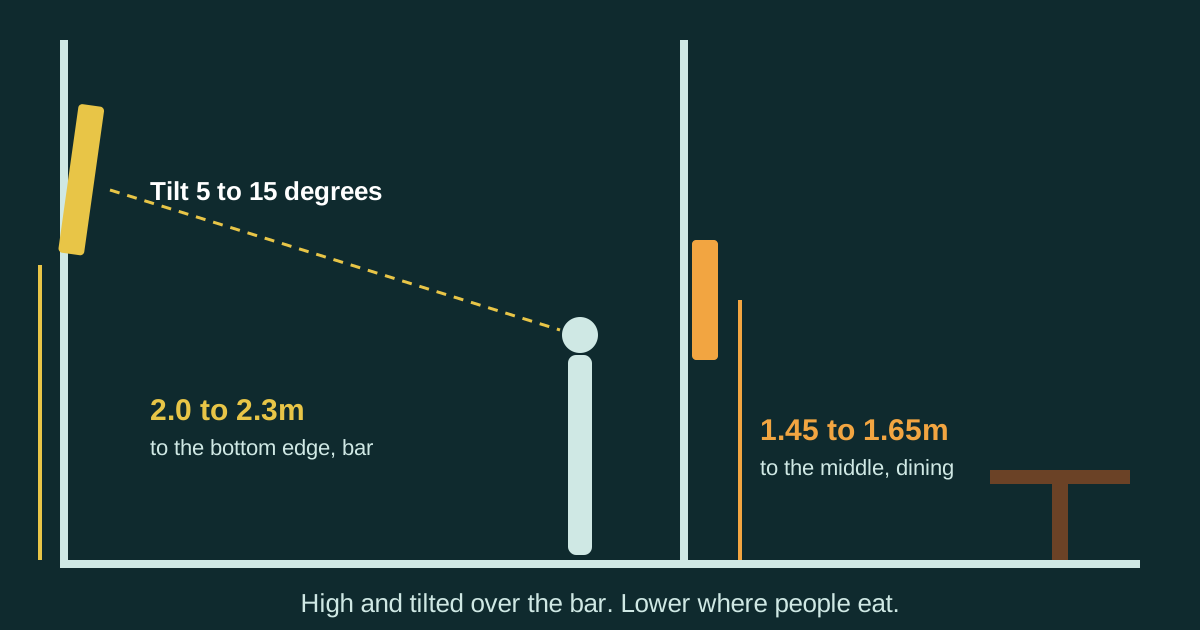
- Over a standing bar or a busy room: bottom edge of the screen about 2.0 to 2.3 metres off the floor, tilted down.
- Where people sit to eat: much lower, with the middle of the screen about 1.45 to 1.65 metres off the floor.
- Tilt: about 5 to 8 degrees down for a bar screen, and more (10 to 15 degrees) if it's very high or people are close.
- Size: the screen's diagonal should be about half the distance to the main viewers.
- Fixings: into brick, or into the timber or metal studs behind plasterboard. Never plasterboard alone.
- Test it first with a bit of cardboard taped to the wall at the height you're thinking of.
Why pub TVs go higher than home ones
At home, the advice is to have the middle of the screen at your eye level when you're sat on the settee. Expert Mounts put that at about 40 to 45 inches, which is roughly 1 to 1.15 metres to the middle of the screen.
In a pub that doesn't work. Someone stands at the bar and the whole table behind them loses the picture. Staff walk past with plates. The quiz team at the back can see the back of a head and nothing else.
So pub TVs go higher, to clear heads, and then tilt down to point back at people's eyes. The trick is going high enough to see over the crowd but not so high that everyone is looking up at the ceiling for 90 minutes.
How high, in metres
Here's what the guides say, turned into metres.
- Cabaret Design Group (a bar designer): bottom of the TV at 90 inches (2.29m) off the floor for most bars, tilted forward 5 to 8 degrees.
- Expert Mounts: in bars and restaurants, bottom edge at 78 to 84 inches (1.98m to 2.13m), tilted down.
- Poster Booking's guide: about 2.1 metres to the bottom of the screen is usually the sweet spot for standing areas. They also say the most common mistake is hanging screens too high.
- Key Digital: bottom edge at least 60 inches (1.52m) in a bar or restaurant, tilted down.
- For seated dining areas, a US installer's guide quoting XTEN-AV puts the middle of the screen at about 57 to 65 inches (1.45m to 1.65m).
Put together, my rule for a pub:
- Standing bar, busy room, darts crowd stood round: bottom edge 2.0 to 2.3 metres.
- Mixed room, mostly sat at tables: bottom edge around 1.6 to 2.0 metres, and point it at the tables.
- Dining room or snug, people sat for an hour or more: middle of the screen at 1.45 to 1.65 metres.
The low ceiling problem
This is the bit the American guides never mention. Plenty of old pubs have low ceilings and beams.
You can work out the top of the screen easily. Expert Mounts give a handy formula: a normal 16:9 screen is about 0.49 times its diagonal in height. So:
- A 43 inch screen is about 53cm tall.
- A 55 inch is about 68cm tall.
- A 65 inch is about 81cm tall.
- A 75 inch is about 93cm tall.
Now say your ceiling is 2.5 metres and you want a 55 inch with the bottom at 2.1 metres. 2.1 plus 0.68 is 2.78 metres. It won't fit. Your choices are a smaller screen, a lower bottom edge (and accept a few blocked views), or a different wall. Leave a gap of 10cm or so above the TV too, so you can get at the bracket and the leads.
Tilt: point it at the people
A TV that's high on the wall and flat to it is pointing at the far wall, not at your customers. Most screens look best when you're looking at them square on.
- Cabaret Design Group: tilt forward 5 to 8 degrees for a bar screen with the bottom at 2.29m.
- Key Digital: when the middle of the screen is well above eye level, tilt down about 10 to 15 degrees, more for longer distances.
- Expert Mounts: if the middle of the screen is above about 60 inches (1.52m), add downward tilt.
If you want the sum, it's just a triangle. Say the middle of the screen is 1.2 metres above the eyes of the people you're aiming at, and they're 4 metres away. The angle is about 17 degrees. If they're 6 metres away, it's about 11 degrees. Most pub screens end up between 5 and 15.
A tilting bracket does this. A tilt also helps with reflections from ceiling lights, which is a bonus.
Side to side: the angle nobody thinks about
The picture on a flat screen gets worse the further round to the side you are. Cabaret Design Group say the picture quality drops off as the side angle increases to about 35 degrees.
Bar Television's layout guide has a good rule: every seat should see a screen without turning more than about 45 degrees from the way they naturally face. That's why one TV in the corner never covers the whole pub, and why several smaller TVs on different walls usually beat one massive one.
What size for the distance?
Bar Television's rule of thumb: the screen's diagonal should be about half the viewing distance to the main viewers. They give 65 inches for people about 3.3 metres away. Their size guide:
- 1.5 to 2.5 metres away: 43 to 50 inch.
- 2.5 to 3.5 metres: 55 to 65 inch.
- 3.5 to 5 metres: 65 to 85 inch.
- More than 5 metres: 85 inch and up, or a projector.
Two more things. A big screen too close to the stools directly under it is a pain to watch, so don't put an 85 inch over a narrow bar. And if the TV is going to show words (a quiz question, your offers, a race card), the back of the room has to be able to read them. Our best TV for a pub guide covers the type of TV, and whether anyone can read what's on it is the whole point of our post on whether anyone is reading your pub TVs.
Pub things to work round
Every pub has its own obstacles. Before you drill, check for these.
- The bar back and the optics. Staff reach up. Don't put a TV where a bottle or an elbow will hit it.
- The dartboard. Keep TVs out of the throwing line and away from where the players stand. Nobody wants a stray dart in a new telly, and nobody wants the oche crowd blocking the screen either.
- The fireplace. Heat and TVs don't mix. Check the TV's manual for how much clear space it needs, and don't put it straight over a real fire.
- Mirrors and windows. A US commercial TV installer's placement guide (DLM Media) lists mirrors behind a bar, windows and glass doors as common glare sources. Their trick: hold something glossy, like a framed picture, where the TV will go and take a photo from the main seats. Any bright spot in the photo will be on the screen.
- Walkways and exits. Keep brackets and swing arms out of the way of people walking, and never cover a fire exit sign.
- Ceiling lights and beams. A spotlight right in front of the screen will bounce straight off it.
The cardboard test
This is the best tip I found, and it costs nothing. It's from that same installer's placement guide.
- Cut a bit of cardboard to the size of the TV you're thinking of buying, or mark the outline on the wall with masking tape at the height you're planning.
- Sit in the furthest seat that's meant to watch it. If it looks small from there, it is small.
- Sit in the nearest seat. If you have to tip your head right back, it's too high or too big for that spot.
- Stay there a few minutes. A sore neck doesn't show up in the first ten seconds.
Do it at the times you're busy too, because a sunny afternoon and a dark Tuesday night are different jobs.
Getting it on the wall safely
A TV coming off the wall over a full bar doesn't bear thinking about. So this bit matters.
Brick or block walls
Fix into the masonry with the plugs and bolts that come with a decent bracket, or that the bracket maker recommends. Check it's actually brick behind the plaster and not a dry-lined wall.
Plasterboard walls
Plasterboard on its own won't hold a pub TV. CMT Group's guide says a self-drill plasterboard fixing is rated for about 18kg hanging down the wall but only about 6kg pulling straight out. A TV bracket sticks out from the wall, so it levers the top fixings outwards, which is the weak direction. It says TVs should go into a stud, not the board alone.
The same guide says that in British Gypsum partition walls the studs are up to 600mm apart, so a bracket wide enough will usually catch two. If you're putting a wall up or re-boarding, add timber noggins between the studs at the height the TV will go.
A UK bracket seller's fitting guide says the same: screw a tilting bracket through the plasterboard into at least two studs, and be careful with swing-arm brackets on stud walls, because when the arm is pulled out the wall takes a lot of force.
The bracket itself
- Rated for more than the TV weighs. Add the bracket's own weight. That bracket seller says they never go over half of a fixing's rating.
- Matches the TV's VESA pattern (the four holes on the back).
- Tilting for high screens. Fixed brackets are fine for low dining room screens. Swing arms only where you really need to aim a TV round a corner, and where nobody will walk into it.
If you're not sure what's behind the plaster, get someone in. It's a lot cheaper than a new TV, and a lot cheaper than a claim.
Leads and power
Plan the cables before the TV goes up. Each screen needs a socket and a picture. If you want the same thing on several TVs, you'll need a splitter, a matrix or a long Cat6 run, and those are much easier to put in before you've decorated. Our guide to connecting multiple TVs in a pub covers which cable goes how far. At Teal Farm the screens run off an HDMI matrix and a spare MacBook.
Plan the lot in five minutes
I've built a free pub TV planner that does all the sums on this page for you. Put in each room's seats, distances and ceiling height and it gives you how many TVs, what size, the height for the bottom edge, the tilt, and a kit list for the splitter or matrix and cables. It prints on A4 so you can hand it to whoever's fitting them.
If one of those screens is going outside, read our guide to an outdoor TV for a pub beer garden first.
Frequently asked questions
How high should a TV be mounted in a pub?
Over a standing bar or busy room, put the bottom edge of the screen about 2.0 to 2.3 metres off the floor and tilt it down. In a dining area where people sit for a while, bring it lower, with the middle of the screen about 1.45 to 1.65 metres off the floor.
Should a pub TV be tilted?
Yes, if it's above head height. A tilt of about 5 to 8 degrees suits a typical bar screen. If the screen is very high or people sit close to it, 10 to 15 degrees is common. A tilting bracket also cuts reflections from ceiling lights.
What size TV for the distance in a pub?
A good rule is a screen diagonal of about half the viewing distance. For people 2.5 to 3.5 metres away that's a 55 to 65 inch. Several smaller screens on different walls usually cover more seats than one huge one.
Can I mount a pub TV on plasterboard?
Not on plasterboard alone. Plasterboard fixings hold far less pulling outwards than hanging down, and a bracket levers outwards. Fix into the timber or metal studs behind the board, or into masonry, and use a bracket rated well above the TV's weight.
What height should the bottom of a TV be over a bar?
Most bar guides put it between about 2.0 and 2.3 metres. One bar designer uses 2.29 metres (90 inches) as the standard. If your ceiling is low, work out the top of the screen first: a screen is about 0.49 times its diagonal tall.
How do I check a TV position before drilling?
Tape the outline of the TV on the wall at the height you're planning, then sit in the nearest and furthest seats for a few minutes. If you're tipping your head back or squinting, move it. A photo of something glossy at that spot shows you where the glare will be.
Sources
- Cabaret Design Group: Bar design ideas: what is the right TV height?
- Expert Mounts: How high to mount a TV, home and commercial
- Poster Booking: Bar digital signage: the 2026 guide to TVs in bars and pubs
- Key Digital: TV mounting height calculator by room
- How and Why's: TV installation for restaurants and bars
- Bar Television: Sports bar TV layout: how many TVs, what size and where
- DLM Media (Sports Direct LLC, US): Commercial TV mounting and placement: a decision guide
- CMT Group: How much weight can plasterboard hold?
- TV Wall Brackets: Fitting TV brackets to stud walls and plasterboard
We checked every source on 18 November 2026. Rules change, so check the latest version before you act. Nothing here is legal advice.