The landlord's blog Games and prizes
Family bingo afternoon in a pub: a free plan the bairns love
How to run a free family bingo afternoon that fills a quiet Sunday. Kid-friendly games, the prize rule most pubs miss, food deals and a two-hour run sheet.
Sunday afternoon in a pub can go one of two ways. Either it's full of families having their dinner, or it's three regulars and the racing on the telly with the place half empty by four o'clock.
A family bingo afternoon is one of the cheapest ways to tip it the right way. Bairns love shouting "house!", mams and dads get an hour off, and everyone stays for another drink and a pudding.
But a family afternoon is a different animal from a cash bingo night. Kids can't play cash bingo at all, and even a "free" game with a prize has a catch most pubs have never heard of. So here's how I'd run one, start to finish, with the rules in plain words.
This isn't legal advice. It's based on the Gambling Act, the Gambling Commission's guidance and GOV.UK. Your council's licensing team has the final say, and your own premises licence may have conditions about children, so read it first.
The short answer
- Make it free. No money to play, no stakes, nothing to buy to join in. Cash bingo in a pub is adults only, so the family version has to be free.
- Keep the prizes worthless (in money). Under the Gambling Act, a game of chance played for a prize counts as gaming even if nobody pays to play. So the safest prizes are bragging rights: a name on the telly, a round of applause, a paper certificate.
- Treats for everyone, not just the winner. A lolly for every child who plays isn't a prize, because it isn't decided by chance.
- Check your licence for children. Many premises licences have conditions about under-18s, like times or areas. Those come first.
- Make the money on food and drink, not on the bingo.
Why family bingo is different from a cash night
In our guide to running a bingo night in a pub, the money comes from the game itself, under strict limits: £5 a person a game, every penny back out as prizes, and no more than £2,000 in stakes or prizes across any 7 days.
The Gambling Commission's page on exempt gaming in pubs is clear that "children and under 18s do not take part" in that kind of gaming. So the moment there's a child at the table, the cash game is off.
That leaves you with a free game. And a free game is great: no money to count, no stakes log, no arguments about the pot. Just the game, the laughs and the bar.
The prize catch most pubs miss
Here's the bit the family bingo posters never mention.
Section 6 of the Gambling Act 2005 says "gaming" means playing a game of chance for a prize. And it says you play a game of chance for a prize whether or not you risk losing anything. A prize, in the Act, means money or money's worth, and it includes a prize put up by whoever runs the game.
Bingo is a game of chance. So a free bingo game where the pub hands the winner something worth money is, on the face of the Act, gaming. It doesn't matter that nobody paid.
Then section 46 of the same Act makes it an offence to invite or allow a child or young person to gamble. There are exceptions, like private or non-commercial gaming, lotteries and some prize gaming at family entertainment centres and travelling fairs. A pub running a family afternoon to sell dinners isn't obviously any of those.
I couldn't find any guidance from the Gambling Commission that says how it treats a bag of sweets for a seven-year-old who gets a full house in a pub. I'm not saying anyone's going to be prosecuted over a Freddo. I'm saying the law doesn't give you a clear yes, so I'd set the afternoon up so the question never comes up.
Prizes that don't cause the problem
These are worth nothing in money, so they aren't a "prize" in the Act's sense:
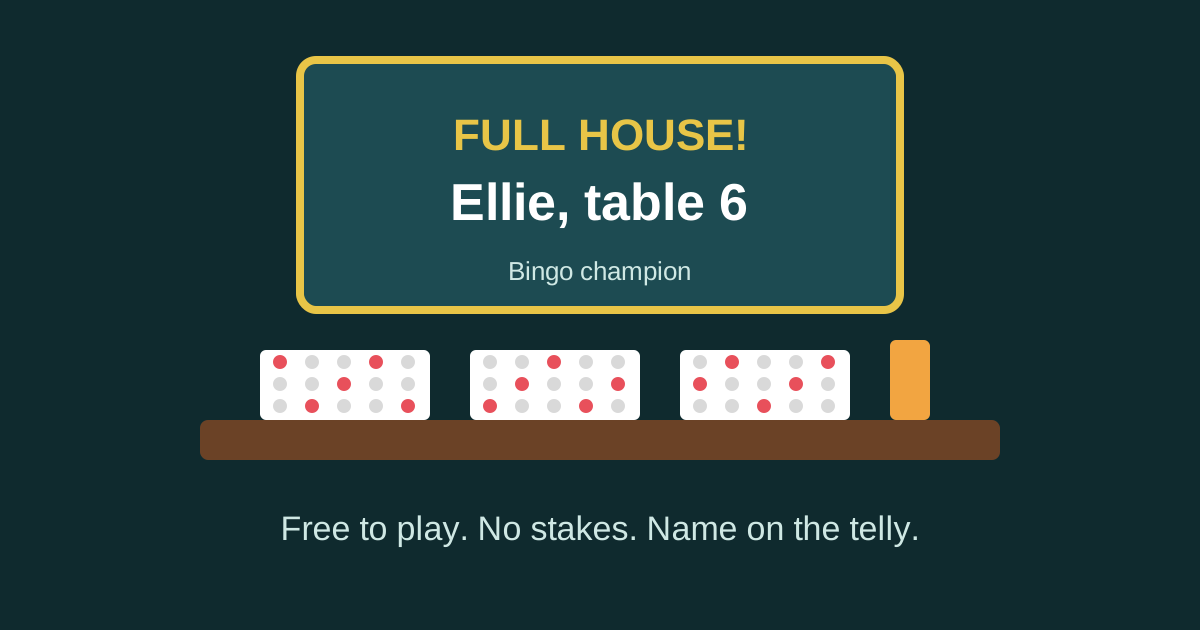
- Name on the telly. "Full house: Ellie, table 6!" on every screen. Kids go daft for it.
- A round of applause and a cheesy fanfare from the speaker.
- A printed certificate: "Teal Farm Bingo Champion, Sunday 22 November". Paper and ink.
- Being the caller for the next game. Every child wants a go on the mic.
- Picking the next game's pattern (four corners, a line, the letter T).
- Wearing the champion's crown, a cardboard one you keep behind the bar and get back.
- A photo on the pub's page, only if the parent says yes, and no faces if they'd rather not.
Treats that aren't prizes
A treat that every child gets, win or lose, isn't won by chance. So these are fine as a thank-you for coming:
- A lolly or a small bag of sweets for every child who plays.
- Free squash or a free scoop of ice cream for every child at the afternoon.
- A colouring sheet and crayons at every table.
Give them out at the start, or at the interval, so nobody thinks they're for winning.
If you really want proper prizes
If the afternoon is run by a school, a club or a charity, not for the pub's profit, it may fall under "non-commercial gaming", which is one of the section 46 exceptions. That has its own rules about where the money goes. Our charity bingo night guide walks through them. Either way, ring your licensing team first and keep their answer in writing.
What the law says about children in the pub
GOV.UK says under-16s may be able to go to a pub, or premises mainly used to sell alcohol, if they're with an adult, and that it can depend on the conditions of the premises.
Two things to know, as set out by the Morning Advertiser and council licensing pages:
- It's an offence to allow under-16s into premises used exclusively or primarily for selling alcohol, unless they're with an adult.
- It's an offence to allow an unaccompanied under-16 on premises open for drinking between midnight and 5am. Not a worry for a Sunday afternoon.
Many licences add their own conditions, like no under-18s after 9pm, or no children at the bar. Breaking a condition is a criminal offence, so dig your licence out before you put the poster up.
And GOV.UK says 16 and 17-year-olds with an adult can drink, but not buy, beer, wine or cider with a meal. Handy to know when the older ones are at the table, but don't let it turn into a drinking afternoon. Keep the focus on the food.
How the games work
Most kids can't follow 90-ball bingo with three lines and fifteen numbers. Make it easy and quick.
For little ones (about 4 to 7): - Use 1 to 60 tickets, or picture bingo (animals, Christmas things, things in the pub). - Play one line wins, then start again. Short games, lots of winners. - Call slowly and show the number big on the telly so they can match it.
For older kids (8 and up): - 90-ball tickets, one strip each. Play a line, then two lines, then a full house. - Mix in patterns: four corners, the letter X, the outside edge.
For mams and dads: let them play too, on the same tickets. It's free, and a dad losing to his six-year-old is half the fun.
Our free bingo ticket maker prints proper 90-ball strips and 1 to 60 strips, plus a caller's sheet for each game, so you can check claims in seconds.
Calling for kids
The old calls are great, but swap the ones that don't work for children. Our bingo calls list has family-friendly swaps. A few that go down well:
- Number 2: "Me and you"
- Number 15: "Young and keen"
- Number 22: "Two little ducks, quack quack" (every child will quack)
- Number 88: "Two fat ladies" becomes "Two snowmen" at Christmas
Get the kids to shout the response back. It keeps the room loud and happy, which is exactly what you want a Sunday to sound like.
Claims
Children shout "house!" when they've got two numbers. Be kind. Check every claim against the caller's sheet out loud, and if it's not right, say "So close! Keep going!" and carry on. No telling off, no disqualifying.
Making it pay
The bingo is free, so the money is in the afternoon around it.
- Book tables. A free event with booked tables tells you how much food to get in.
- A family deal: kids' meal and a drink at a set price, or a Sunday dinner deal for the adults. Keep it separate from the bingo so nobody has to buy anything to play.
- Pudding at the interval. Stop after game four and sell ice cream sundaes and hot chocolates.
- Keep the adults in. A coffee and a cake, or a pint for whoever's not driving, while the kids play.
- Plug the next one. Put the date of the next family afternoon on the telly at the end.
One thing to avoid: don't tie the bingo to buying anything. "Free ticket with every kids' meal" sounds harmless, but a ticket you only get by paying starts to look like a payment to play. Free means free, for everyone at the table.
A two-hour run sheet
Here's a plan for a Sunday from 2pm to 4pm.
- 1:00pm Print tickets and caller's sheets. Set up the TVs. Lay out dabbers or pens, crayons and colouring sheets.
- 1:45pm Doors for bookings. Treats and squash on the tables.
- 2:00pm Welcome and the rules: free to play, shout "house!" loud, everyone gets a turn. Game 1 for the little ones, one line wins.
- 2:15pm Game 2, little ones again. Then let a child call game 3.
- 2:35pm Game 3 for older kids and adults: line, two lines, full house.
- 2:55pm Interval. Puddings and hot drinks. Certificates for the winners so far.
- 3:15pm Games 4 and 5, with patterns.
- 3:40pm The big final game, everyone in, full house only. Winner gets the crown, the certificate and their name on every screen.
- 3:55pm Thanks, photos (with permission), and the date of the next one on the telly.
Ten-minute games keep kids happy. If attention goes, play a quick picture bingo or stop early. Nobody ever complained that the bingo finished five minutes before the pudding.
Safeguarding, the sensible bits
- Children stay with their adults. Make that part of the welcome.
- Photos only with a parent's yes. And never post children's faces without it.
- Staff who know the plan. Who calls, who checks claims, who keeps an eye on the door.
- Keep the bar side calm. If the licence lets kids in, it doesn't mean they should be stood at the bar.
How StockTap TV fits in
On Sunday afternoons the TVs are usually showing nothing much. StockTap TV can put free phone bingo on your screens: everyone plays on their phone, there are no stakes, and the game checks lines and full houses itself, so there's no squinting at a crumpled ticket. It's free to play with no prizes built in, which suits a family afternoon down to the ground.
For more ideas on what to give away at your other bingo games, see our list of bingo prize ideas for pubs.
Frequently asked questions
Can children play bingo in a pub?
Not cash bingo. The Gambling Commission says children and under-18s don't take part in exempt gaming in pubs, which is where cash bingo sits. A free game with no stakes is different, but keep prizes to things with no money value, like a name on the TV or a certificate, because the Gambling Act counts a free game of chance for a prize as gaming.
Can I give sweets as a bingo prize to kids?
The law doesn't give a clear yes. The Gambling Act says gaming means a game of chance for a prize, whether or not the player risks losing anything, and a prize means money or money's worth. A safer way is a treat for every child who plays, win or lose, which isn't decided by chance.
Do I need a licence for family bingo?
For a free game with no stakes and no money-value prizes, you're not running cash bingo, so the £5 and £2,000 limits don't come into it. You do still need your premises licence to allow children at that time, and any conditions in it apply. If in doubt, ask your council's licensing team.
What age is family bingo for?
Any age that can match a number, with an adult. Picture bingo or 1 to 60 tickets work for about 4 to 7, and 90-ball for 8 and up. GOV.UK says under-16s may be able to go into a pub with an adult, depending on the premises.
How long should a family bingo afternoon be?
About two hours, with games of ten minutes or so and a break in the middle for food. Kids lose interest in long games, so play lots of short ones with plenty of winners.
Can the pub charge for family bingo?
Charging kids to play bingo for prizes takes you into gambling with children, which isn't allowed. Keep the game free and charge for food and drink as normal, without making the game depend on buying anything.
Sources
- legislation.gov.uk: Gambling Act 2005, section 6 (gaming and game of chance)
- legislation.gov.uk: Gambling Act 2005, section 46 (invite to gamble)
- Gambling Commission: Exempt gaming in pubs
- Gambling Commission: Guidance to licensing authorities, Part 27 prize gaming
- GOV.UK: Alcohol and young people
- Morning Advertiser: Children in pubs: what does the law actually say?
- Adur and Worthing Councils: Licensing Act 2003 and children
We checked every source on 16 November 2026. Rules change, so check the latest version before you act. Nothing here is legal advice.