The landlord's blog Games and prizes
Charity bingo night in a pub: the rules, prices and a run sheet
How to run a charity bingo night in a pub that raises proper money. The £8 and £600 limits, when donated prizes beat cash, Gift Aid, what the pub keeps, and a run sheet.
Every pub gets the ask sooner or later. "Can we do a bingo night for the hospice?" A regular's raising money after losing their mam, a junior football team needs new kits, a school wants a minibus.
Say yes. A charity bingo night is one of the easiest fundraisers there is. People know how to play, it works for any age of grown-up, and a room full of people for three hours is good for your bar too.
But charity bingo isn't the same as the cash bingo a pub can run on a normal night. The rules are different, and the choice you make at the start decides how much you can charge, what prizes you can give and how much the charity ends up with. Most of the charity guides you'll find online tell you to "check the Gambling Commission website" and leave it there. This one gives you the rules, the sums and a run sheet.
It isn't legal advice. It's based on the Gambling Commission's own guidance. Your council's licensing team has the final say on your premises.
The short answer
A charity bingo night in a pub is legal with no gambling licence, if it's run as non-commercial gaming:
- every penny of profit goes to the good cause, after reasonable costs
- everyone is told which good cause it's for before they play
- nobody makes a private profit from the gaming
- it's played in the room, not online
Then you pick one of two routes:
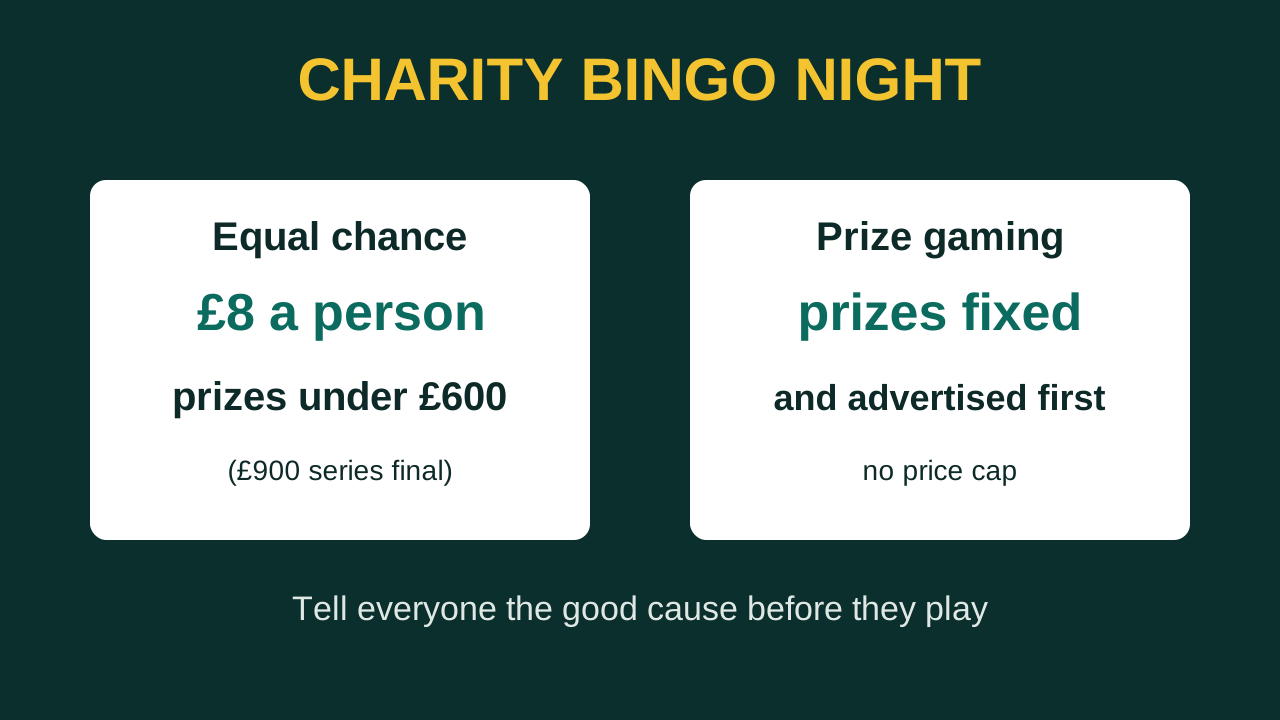
- Equal chance gaming: proper bingo where the prizes can come from the money taken. Each person pays no more than £8 for all the games on the day, and total prizes stay under £600 (up to £900 if it's the final of a series everyone has played in).
- Prize gaming: you set the prizes in advance, and they don't change with how many turn up or how much is raised. There's no cap on what you charge per person or on the prizes.
Which route raises more money?
This is the decision that matters, so here's how it plays out.
Route 1: equal chance (the £8 route)
Good when the prizes will be cash, or when you don't have many donated prizes.
Say 70 people come. You charge £8 for a book that covers every game. That's £560 in. If you pay out £250 in cash prizes across the night, and your costs (tickets, printing) come to £20, the cause gets £290 from the bingo. Then you add the raffle, the bucket and the food.
The £8 is everything a person pays for the gaming that day, including any entry fee. So it's not £8 plus a £3 entry. And the £600 prize cap counts "money's worth", so a donated hamper counts towards it at its value, not just cash.
Route 2: prize gaming (the donated prizes route)
Good when local businesses are giving you prizes, which they usually will for a charity.
You decide the prizes before the night and advertise them: game 1, a meal for two; game 2, a £30 hairdresser voucher; the house on the last game, a signed shirt. Those prizes stay the same whether 40 people come or 100.
Because there's no £8 cap here, you could sell books at £10. 70 people at £10 is £700. If every prize is donated, the cause gets £700 less your few pounds of costs. That's well over double route 1.
The catch is the one rule you can't bend: the prizes must not depend on how many play or how much is raised. No "half the pot to the winner" on this route. If you want a pot, use route 1.
Our take
If you've got four or five decent donated prizes, go for prize gaming. If it's going to be cash prizes, go for equal chance and keep within £8 and £600. Don't mix the two in one night without asking your licensing team, because it gets muddy fast.
What the pub can and can't keep
This is the bit landlords worry about, and it's fair to.
- Bar and food takings. The guidance says sums raised by other people, like refreshments sold by an independent third party, aren't part of the event's proceeds and can be kept. So what goes through your till stays yours. Plenty of pubs give a bit back anyway, say a pound from every pie and pea supper, but that's your choice.
- The bingo money. None of it. The pub can't take a cut of book sales, a "service charge" or a share of the pot. That would be private gain.
- Room hire. Organisers can take off costs "reasonably incurred" in organising the event. A room charge might be one, but most landlords waive it because the bar does well. If you do charge, agree it up front, keep it modest and write it down so nobody can say later the pub took the money.
And one thing that catches people out: the normal pub cash bingo rules (£5 a game, all stakes back as prizes) don't let you raise anything for a cause, because every penny of stakes has to go back out. If you want to raise money from the bingo itself, it has to be one of the two non-commercial routes above.
Can you claim Gift Aid?
Not on the bingo books. HMRC says Gift Aid can't be claimed on payments for goods and services, or on tickets for an event you've organised. A bingo book is a payment to play.
What can qualify is a genuine donation on top. HMRC says a "minimum donation" doesn't count, but anything extra that people choose to give does, and at a "donation only" event all donations qualify. So put a bucket and some Gift Aid envelopes from the charity on the tables, and ask people to tick the box if they're a UK taxpayer. The charity will tell you exactly what they need.
Kids and charity bingo
The Gambling Commission says under-18s can take part in some kinds of non-commercial gaming, but the page doesn't spell out every case, and in a pub you've also got your alcohol licence rules to think about. My advice: if there's money on the bingo, make it a grown-ups' night. If you want a family afternoon, run free bingo with no stakes and no money prizes, and raise the money through the bucket and the cake stall instead.
Six weeks out: the plan
- 6 weeks: agree a date with the organiser. Midweek works well. Agree who's responsible for what: the organiser runs the bingo, the pub runs the bar. Confirm the good cause and get their logo and charity number if they're registered.
- 5 weeks: pick your route (equal chance or prize gaming). Set the book price.
- 4 weeks: start asking local businesses for prizes. Hairdressers, takeaways, garages, the butcher. Write down what each prize is worth.
- 3 weeks: posters up in the pub, on the pub page and in the local groups. Say clearly which good cause it's for, the price and, for prize gaming, the prizes.
- 2 weeks: sort the kit: tickets, a caller, a mic, a board or TV to show the called numbers, a cash tin and a float. Our free bingo ticket maker prints proper 90-ball strips and a caller's sheet for every game.
- 1 week: brief the staff. Who's selling books, who's checking claims, who's on the bar.
- On the day: rules card on every table, the good cause written up where everyone can see it, prizes on show.
A run sheet for the night
- 6:45pm Organiser and caller in. Test the mic from the back corner. Prize table set up.
- 7:00pm Doors and bar. Book sales open. A sign by the table says the good cause and the price.
- 7:30pm Welcome. Say who the money's for and the house rules: how to claim, what happens if two people claim on the same number, late claims don't count.
- 7:35pm Games 1 and 2. Line, two lines, full house.
- 8:15pm Game 3.
- 8:35pm Break. Food out, raffle tickets on sale, bucket round.
- 9:00pm Games 4 and 5.
- 9:40pm Raffle draw.
- 9:50pm Final game, the big prize.
- 10:10pm Thank everyone, announce a rough total, say when the final figure will be posted.
A full game takes about 15 to 20 minutes from line to house, so six games with a break fits nicely into three hours.
If you're adding a raffle, there are rules on that too. We went through them in how to run a charity race night in a pub, and they apply just the same at a bingo night.
Counting and handing over the money
This is where trust is won or lost. Do it the same way every time.
- Two people count, always. The organiser and someone from the pub, together, at the end of the night.
- Write it down by stream: book sales, raffle, bucket, any food donation. Then costs, with receipts.
- Both sign the sheet. Take a photo of it.
- Bank it to the charity quickly. Most charities let you pay in by phone, bank transfer or cheque, or straight onto the fundraising page. Use their method and keep the receipt.
- Post the total. "You lot raised £1,042 for the hospice last night." That post will do more for your next charity night than any poster.
Keep the cash apart from the till all night. A separate tin with a separate float means no one can ever say the money got mixed up.
What makes a charity bingo night go well
- A caller with a bit of life about them. Our bingo calls list has every call from 1 to 90.
- The cause up front. A two-minute word from someone the charity helped beats any poster.
- Prizes on show. People buy more raffle tickets when they can see what they're playing for.
- Food in the break. Pie and peas, a buffet, whatever you do well. It keeps people in for the second half.
- Finish on time. Better they leave wanting another game than drift off before the last one.
If the charity wants the full legal detail, point them at is bingo legal in pubs, which covers every type of pub bingo in one place.
Frequently asked questions
Do you need a licence for a charity bingo night?
No gambling licence is needed if it's run as non-commercial gaming: the profits go to the good cause, players are told the cause in advance, nobody makes a private profit and it's played in the room, not online. You'll still need the pub's alcohol licence, or a TEN, for the bar.
How much can you charge for charity bingo?
On the equal chance route, no more than £8 per person for all the games that day, including any entry fee, and total prizes under £600. On the prize gaming route there's no limit on the price, but the prizes must be fixed in advance and not depend on how many play.
Can the pub keep the bar takings from a charity bingo night?
Yes, as long as the charity or organiser runs the bingo and the pub just runs the bar. The guidance says sums raised by others, such as refreshments sold by an independent third party, aren't part of the event's proceeds. The pub can't take any share of the bingo money itself.
Can you claim Gift Aid on bingo tickets?
No. HMRC says payments for goods and services or tickets for events don't qualify. Separate voluntary donations, like a bucket collection, can.
Can you run charity bingo online?
No. The Gambling Commission says bingo for fundraising can't be played virtually or online without a licence.
Do donated prizes count towards the £600 limit?
On the equal chance route, yes. Goods, vouchers and goody bags count at their value. On the prize gaming route there's no cap, but the prizes must be set and advertised in advance.
Sources
- Gambling Commission: Bingo for fundraising
- Gambling Commission: Guidance to licensing authorities, Part 28: Non-commercial gaming
- Gambling Commission: Bingo as exempt gaming in pubs
- Hinckley and Bosworth Borough Council: Gaming in pubs and other alcohol licensed premises
- GOV.UK (HMRC): Gift Aid donation claims for charities and CASCs
- PTA UK: Step-by-step: bingo event
We checked every source on 12 November 2026. Rules change, so check the latest version before you act. Nothing here is legal advice.