The landlord's blog Games and prizes
Pub Darts Team: How to Start One and Join a League
How to start a darts team at your pub, find and join a local league, what it costs, what the players expect from you and how to make darts night pay.
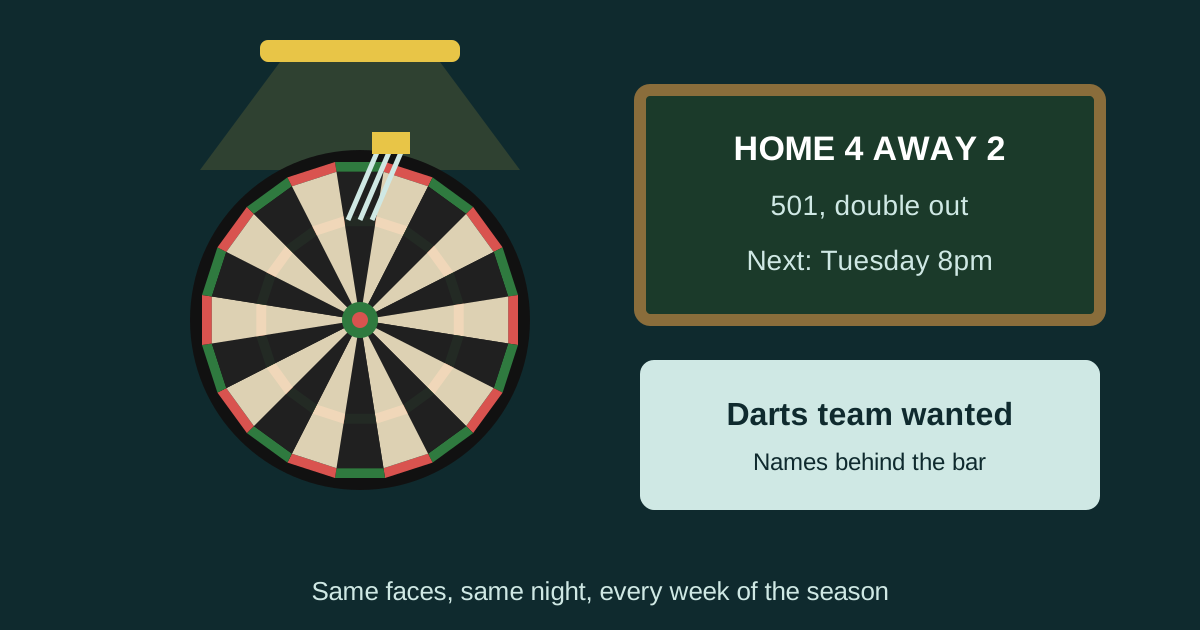
A darts team is the oldest trick in the pub book for filling a quiet night, and it still works. Every home match brings in your own team, their mates, and a full team from another pub, on the same night every week, all season.
Plenty of pubs have lost their teams over the years, though, and getting one going again isn't as simple as hanging a board. This guide is how to start a pub darts team, find and join a local league, what it all costs, what the players will expect from you and how to make darts night pay. Sources are at the bottom.
The short answer
- Get the board right first. Bullseye 1.73m off the floor, oche 2.37m from the face of the board, good light, space to throw.
- Find four to eight regulars who'll commit to one night a week. Ask at the bar, on your Facebook page and in local groups.
- Join your local league. Most towns have one, with lower divisions for new teams. Seasons usually run autumn to spring.
- Or start your own in-house league if there's no league nearby or your lot aren't ready.
- No licence is needed for a pub game of darts. Home Office guidance says games like darts and pool aren't licensable.
- The deal with the team: you give them the board, the night and usually a bit of food. They give you a full pub on a quiet night.
Why a darts team is worth having
Think about what a home match night actually brings in. Your team, maybe six to eight players. Partners and mates who come to watch. The away team, who all need a drink and something to eat. And they come back every week for months.
A guide to running UK darts clubs from ClubHelix puts the usual deal well: the venue provides boards, lighting, space and storage; the club brings a reliable crowd of thirsty regulars every week. A league organiser's guide from Sports League Hub adds that venues generally welcome a league night because it fills a quiet evening.
It's also about who comes in. Darts teams tend to be the locals who'd otherwise drink at home midweek. And unlike a quiz, you don't have to host anything.
Step 1: get the board and the space right
Before anyone joins a league, your board has to be the right height and distance, because leagues expect the same set-up everywhere. Sports League Hub gives the standard measurements:
- Bullseye height: 5ft 8in (1.73m) from the floor to the centre of the bull.
- Throwing distance: 7ft 9¼in (2.37m) from the face of the board to the oche (the throwing line).
We've got a full guide on dartboard height and distance, and setting up a pub board properly on the main StockTap site.
Beyond the measurements:
- A decent bristle board. ClubHelix recommends turning boards regularly so the wear around the 20 spreads out, and keeping a spare. A tired board with loose wires is no good on match night.
- A light over the board with no shadows across the doubles.
- A surround and a mat to protect the wall and the floor, and mark the oche properly.
- A scoreboard. Chalk is traditional. Plenty of players now score on a phone or tablet.
- Space and safety. Nobody walking between the oche and the board, no doorway or toilet route through the throwing lane, and room behind the thrower for the team.
If you've got room for two boards, even better. Match nights go quicker and casual players aren't stuck waiting.
Step 2: find your players
You only need a handful to start. Team sizes vary by league, so check yours, but sides of four to six are common, and Sports League Hub suggests eight to sixteen players is right for a first in-house season.
Where to find them:
- Your own regulars. Watch who throws a few arrows on a quiet night. Ask them straight out.
- A sign by the board and a post on your Facebook page: "Fancy a darts team? Names behind the bar."
- Local groups on Facebook. There are players who've lost their team when a pub shut and want a new home.
- A taster night. ClubHelix suggests social nights where newcomers borrow club darts and have a friendly game. Most future league players first walk in for one relaxed night.
Then pick a captain. Someone reliable, who'll sort the team sheet, chase players and deal with the league. You don't want to be doing this yourself on top of running the bar.
Step 3: find and join a local league
Most towns have at least one pub darts league, often on a weeknight. A guide on SportReady says leagues run in every town, play through a season from autumn to spring, and have divisions that let a new team start near the bottom.
How to find yours:
- Ask other pubs with darts teams, especially the ones you'd be playing.
- Search Facebook for your town's darts league.
- Try your county darts organisation's website for league contacts, as one darts forum suggests.
- Use darts venue and league finder sites, which list boards and league nights near you.
Joining usually means an application form, agreeing to the league rules, and paying a fee or deposit. As an example, one Staffordshire league asks new teams for a £50 deposit, refunded when you complete your fixtures.
Timing matters. New teams are normally taken before the season starts, so if it's mid-season, get your players throwing together now and apply for the next one. Players can often practise with a team and join properly at the next registration window.
What it costs
Darts is about as cheap as team sport gets. SportReady puts a starter set of darts at about £15 to £30 and league membership at about £15 to £30 for a whole season. ClubHelix describes the common model as a modest annual membership plus a small weekly board fee on league nights that pays for prizes and trophies.
On top of that, the pub usually covers the board, the light and the space. Many pubs also sponsor the team shirts or the end-of-season trophies. It's cheap advertising: your pub's name on the back of every player at every away match.
No league nearby? Start your own
If there isn't a league near you, or your lot want something more relaxed first, run one in the pub. Dartsy's guide to running a pub darts league suggests deciding five things before anyone throws a dart:
- Singles or teams. Individual leagues are simpler; pairs or teams are more social.
- Season length. 8 to 12 weeks is about right for a casual league.
- Match format. The standard is 501, best of three legs, finishing on a double, with nearest the bull throwing first.
- Entry fee and prizes. Dartsy suggests £5 to £10 per player per season for a prize pot, with prizes for the winner, runner-up and something like most improved.
- Board time. Make sure the board is theirs on the same night every week.
A round-robin, where everyone plays everyone once, is the fairest. For 8 players that's 7 weeks, plus a finals night. Two points for a win and leg difference to split ties keeps the table simple. Then a knockout for the top four on the last night.
Fifteen minutes of admin a week keeps it alive: remind people who's playing who, put the results up, update the table. Dartsy's warning is spot on: shared responsibility means nobody does it. One person owns the table.
Keep it fun for the bottom half
A league that only rewards the top three slowly empties. ClubHelix suggests a handicap event or a most improved award. Novelty games help too: killer, round the clock, blind doubles for pairs drawn out of a hat.
Your side of the deal: what the team expects
Sports League Hub makes a point every landlord should hear: almost every collapsed pub league traces back to a booking that was never really confirmed. Agree it properly with the captain, and write it down:
- Which night is theirs, and that the board is kept free for them from a set time.
- What happens on function nights or big football. Tell them weeks ahead, not on the night.
- Who buys and replaces boards, flights and chalk.
- Food on home match nights. Ask the captain what the league expects. Some leagues have food for both teams as part of the night, others don't. Whatever you agree, sandwiches, chips or a pot of stew, keep it the same every home match.
- A drinks deal, if you want, like a team price on a jug or a round for the winners.
- A space to leave the team's darts and trophies.
A pub that treats its team well keeps it. One that bumps them for a birthday party twice in a season loses them to the pub up the road.
Licensing and rules
The darts itself: Home Office guidance issued under section 182 of the Licensing Act 2003 lists games played in pubs, like pool, darts and table tennis, as not licensable. It also explains the line: a darts championship put on partly to entertain an audience could be licensable, but a pub game of darts played for the enjoyment of the players is not.
Bigger exhibitions: if you host an exhibition match with a crowd, GOV.UK says an indoor sporting event doesn't need a licence between 8am and 11pm if there are no more than 1,000 spectators. Your premises licence conditions and capacity still apply.
Money: keep subs and prizes simple and visible, with a written note of who's paid and what the prizes are. If you start running cash-prize competitions open to anyone, check with your licensing officer first. Trophies, a pot from subs and a meal keep it simple.
Safety: a dart is a sharp thing thrown across a pub. Keep the throwing lane clear, don't let anyone who's had too many throw, and keep kids well away from the board.
Making darts night pay
- Fill the night around the match. Put the fixtures and a match-night offer on your screens and Facebook a few days ahead, like you would for football. Our guide on what to put on your pub TVs has ideas.
- Show the league table. Players love seeing it. Print it by the board and share it in the team chat each week.
- Darts on the telly. Big televised darts nights bring in people who want to watch together. If you show them, make sure your subscription is a commercial one.
- Prizes that bring people back. Season trophies, a bar tab for the most improved, a meal for the team that wins the cup. Our guide on prizes that bring people back covers what works.
- Raise money together. Darts teams are a ready-made crowd for a charity night. A race night for a sports club works just as well for a darts team.
Frequently asked questions
How do I start a darts team at my pub?
Set up a board at the right height and distance, find four to eight regulars willing to play one night a week, pick a reliable captain and either join your local league before the season starts or run your own in-house league. Agree the night, food and board time with the captain in writing.
How do I find a local darts league?
Ask pubs that already have darts teams, search Facebook for your town's darts league, check your county darts organisation's website and use darts venue finder sites. Most towns have at least one league, with lower divisions for new teams.
How much does it cost to join a darts league?
It varies by league. One guide puts league membership at about £15 to £30 a season per player, with a starter set of darts about £15 to £30. Some leagues also ask new teams for a deposit, such as £50 refunded when you finish your fixtures.
What is the standard dartboard height and throwing distance?
The bullseye should be 1.73m (5ft 8in) from the floor, and the oche 2.37m (7ft 9¼in) from the face of the board. Leagues expect the same set-up everywhere so scores are fair, so measure it properly.
Do you need a licence for darts in a pub?
No, not for a pub game. Home Office guidance under the Licensing Act 2003 says games played in pubs, like darts and pool, aren't licensable. A darts event put on to entertain an audience could be different, though indoor sport between 8am and 11pm with up to 1,000 spectators needs no licence.
When does the darts season start?
Most pub leagues run from autumn to spring, with new teams usually taken before the season starts. Check with your local league for registration dates, and use any gap to get your team practising together.
Sources
- Sports League Hub: How to Start a Darts League
- Dartsy: How to Run a Pub Darts League
- ClubHelix: How to run a darts club in the UK
- SportReady: Darts in the UK: leagues, clubs, boards and coaching
- Trent Valley Darts League: How to Join
- Darts Nutz forum: Getting involved in league darts
- Home Office: Revised Guidance issued under section 182 of the Licensing Act 2003, chapter 16 (regulated entertainment)
- GOV.UK: Entertainment Licensing
We checked every source on 20 November 2026. Rules change, so check the latest version before you act. Nothing here is legal advice.